
If you freelance in Canada, GST/HST is the tax question that tends to sneak up on people. The rules aren't complicated once you see them laid out — here's the whole flow, from "do I even need to charge it" to filing your first return.
Do you even need to charge it?
Most new freelancers start as a small supplier. You stay a small supplier until your taxable revenue crosses $30,000 over four consecutive calendar quarters (or in a single quarter). Until then, registering for GST/HST is optional.
Plenty of freelancers register before they have to. The reason is input tax credits — once you're registered, you can claim back the GST/HST you pay on business expenses like software, a laptop, or your accountant's fee. If you buy a lot of taxable inputs, voluntary registration can pay for itself.
Registering with the CRA
Registration gives you a GST/HST account tied to your Business Number. You can register online through CRA My Business Account, by phone, or by mail. Pick your effective date carefully — you have to start charging tax from that date forward, so don't backdate it past your first taxable invoice unless you mean to.
Charging the right rate
The rate you charge generally follows your customer's province, under the CRA's place-of-supply rules — not where you happen to sit. That means 5% GST for some provinces and HST in the participating ones (for example, 13% in Ontario). A freelancer with clients in three provinces may be charging three different rates on the same week's invoices, which is exactly the kind of thing worth automating.
What to track all year
A clean return is mostly a tracking problem. Keep:
- The tax you collected — every invoice should show GST/HST as a separate line, not folded into your rate.
- Receipts for business purchases — these back up the input tax credits you'll claim, so the vendor, date, total, and tax all need to be legible.
- Which province each sale belongs to — so the rate on the invoice matches the rate on your return.
Filing your return
When your reporting period ends, your net tax is simple arithmetic:
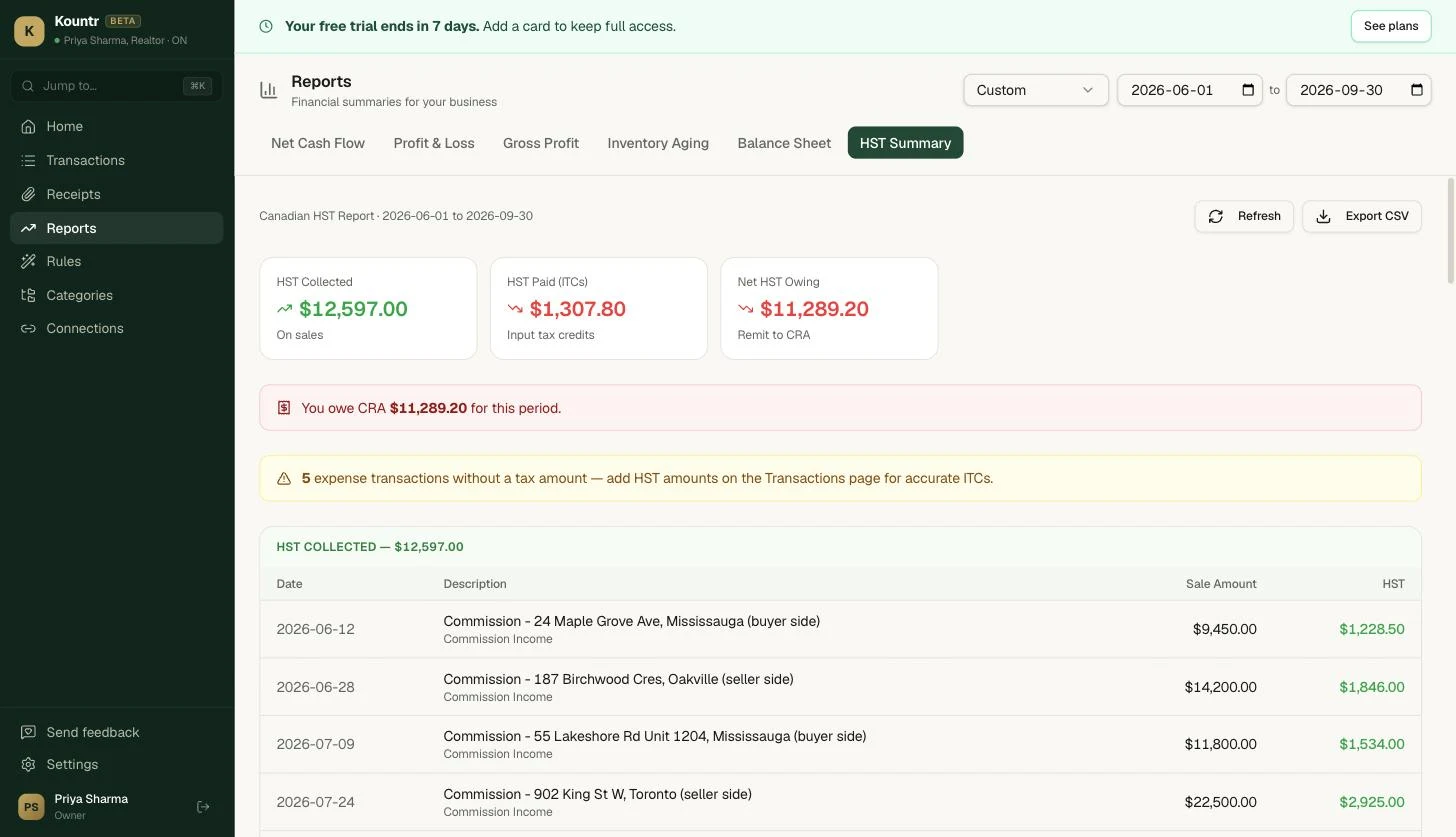
GST/HST you collected − input tax credits you're claiming = what you remit.
If you collected more than you paid out, you send the CRA the difference. If your input tax credits were larger, you're owed a refund. You file through CRA My Business Account on the schedule the CRA assigns you — annual, quarterly, or monthly. (Income tax is separate: your business income flows onto the T2125 with your personal T1.)
Make it run itself
The freelancers who never stress about HST aren't more organized — they just stopped doing it by hand. If you'd rather your bank feed, receipts, and per-province tax roll into a CRA-ready return automatically, that's exactly what Kountr's bookkeeping software for Canadian freelancers is built for.
Quick answers
Do I have to register for GST/HST as a freelancer?+
Only once you cross the small-supplier threshold — $30,000 in taxable revenue over four consecutive calendar quarters (or in a single quarter). Below that, registering is optional, though it lets you claim input tax credits on business purchases.
What rate do I charge?+
It depends on the province of your customer under the CRA's place-of-supply rules — 5% GST in some provinces, or HST (for example 13% in Ontario) in participating provinces. Always confirm the current rate for your situation with the CRA.
When is my GST/HST return due?+
It depends on your assigned reporting period — annual, quarterly, or monthly. Your net tax is the GST/HST you collected minus the input tax credits you're claiming, filed through CRA My Business Account.