
Ontario car dealers don't submit a single "OMVIC report." What they actually have are three separate obligation streams: things you report directly to OMVIC, records you keep on-site for inspectors and consumers, and written disclosures you make on every vehicle contract. Mixing these up is where most compliance headaches start.
This post covers what each bucket requires, what changed in 2026, and the record-keeping habits that make all three easier to manage.
What "OMVIC compliance" actually means for a dealer
OMVIC — the Ontario Motor Vehicle Industry Council — administers the Motor Vehicle Dealers Act (MVDA) and its regulation, Ontario Regulation 333/08. If you sell, lease, or trade motor vehicles in Ontario, you must be registered with OMVIC. Full stop.
There are seven registered dealer classes under the MVDA: general dealer (new/used, or used-only), broker, wholesaler, exporter, lease finance dealer, fleet lessor, and outside-Ontario dealer. Each class carries the same core compliance obligations, though the specific details can vary.
The confusion around "OMVIC reporting" usually comes from treating it as one thing. It isn't. Think of it as three lanes.
Lane 1: What you report directly to OMVIC
Transaction fees at annual renewal
Every time you sell or lease a vehicle to an end consumer, a transaction fee accrues. As of September 1, 2025, that fee is $22.00 per vehicle (cars, vans, trucks, SUVs, motorcycles — any road-use motor vehicle).
You don't submit this per-sale. Instead, dealers self-report the total count of qualifying transactions and remit the accumulated fees with their annual registration renewal. An officer, all partners, or the sole proprietor must sign the renewal form attesting that the vehicle count is accurate.
Exemptions exist for dealer-to-dealer sales and leases, lessees buying out a vehicle at lease end, and certain fleet/commercial transactions. Watercrafts, farm equipment, construction machinery, and snowmobiles are excluded entirely.
OMVIC verifies the reported count against Ministry of Transportation registration data. Minor variations are acceptable; deliberate underreporting can result in administrative action. Your books need to tell the same story as the MTO's records.
Legally required notifications within five days
OMVIC requires dealers and salespersons to notify them within five days of any of the following:
- Registration information changes — business name, address, or designated class
- Criminal charges — particularly any charges related to fraud or theft
- Share ownership changes — when issued or transferred shares result in a person holding 10% or more of all outstanding shares
Miss these and you risk disciplinary proceedings or a Notice of Proposal to revoke your registration. Five days is a short window. The practical fix is building a simple internal checklist so that major business events trigger an OMVIC notification review before the week is out.
Lane 2: Records you must maintain
OMVIC inspectors can walk into your dealership and ask to see records. Sections 52–54 of Ontario Regulation 333/08 specify what you must have available. The retention period is six years, kept at a location approved by the Registrar.
Required records checklist
| Record category | What's included |
|---|---|
| Personnel | All employees: positions, dates of employment, compensation, proof of payment |
| Vehicle inventory | Vehicles in dealer possession for trade purposes |
| Sales and leases | Contracts for every vehicle sold or leased to consumers |
| Trade-ins | Documentation for each trade-in transaction |
| Consignment agreements | Full agreements for vehicles sold on consignment |
| Financial transactions | Loan agreements, credit arrangements, and all financing records |
| Trust accounts | Records for deposits exceeding $10,000 and for qualifying consignment transactions |
The format — paper or electronic — is not specified by the MVDA, so either works. If you store records electronically off-site (on a cloud server or third-party system), OMVIC's electronic record-keeping guideline requires Registrar approval. On-site electronic records don't need prior approval, but they must be printable on request, in a legible format (PDF is the recommended standard), and protected by appropriate security controls.
The practical implication for your books
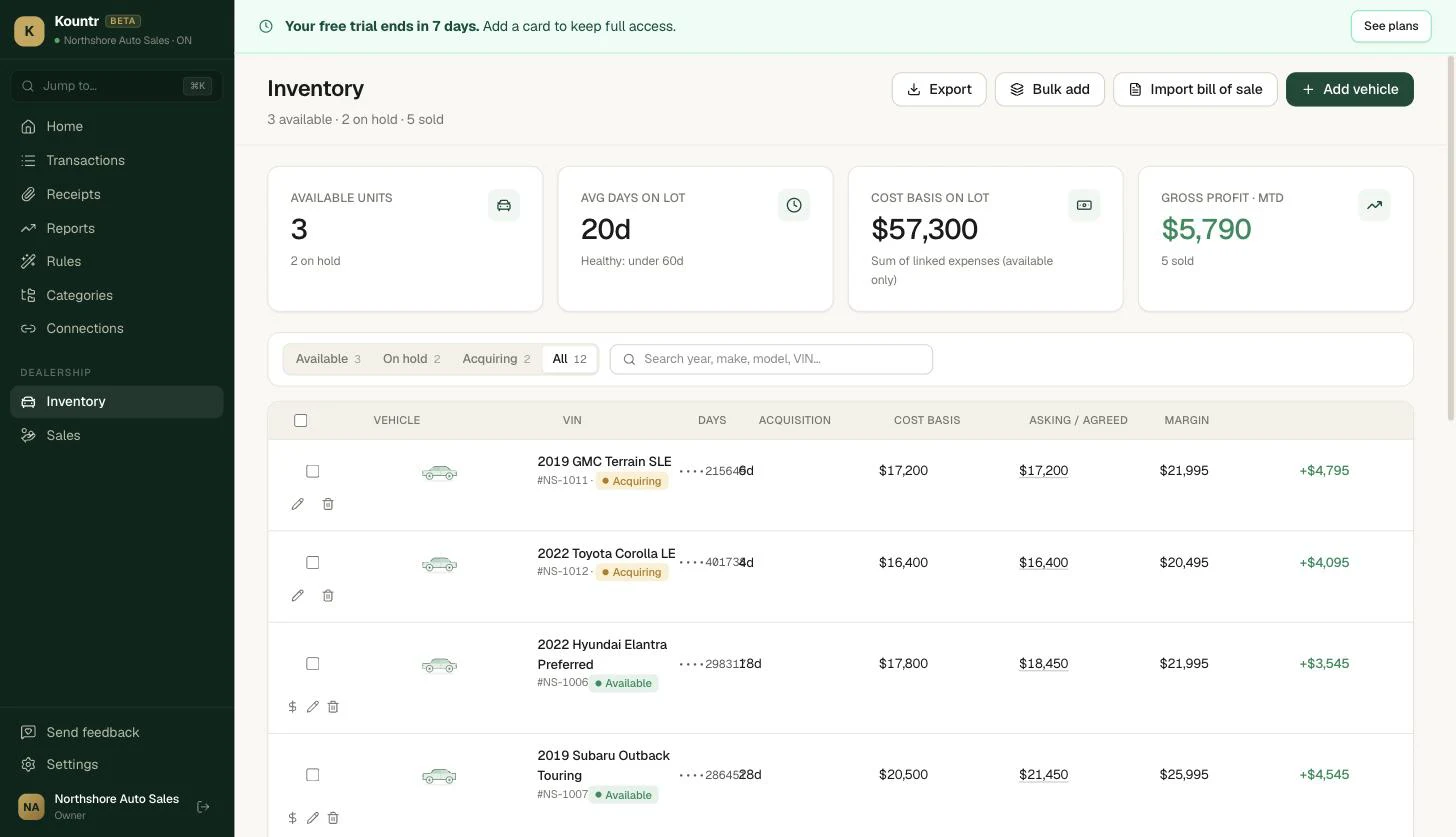
The six-year retention rule and the transaction fee self-report are two sides of the same coin. Your vehicle-level sales records are both the compliance document and the source of truth for your annual fee remittance. Dealers running accurate per-unit books — with each vehicle tracked from acquisition through sale — have a straightforward time at renewal and at inspection. Dealers reconstructing records from memory and bank statements do not.
If you use dealer accounting software that tracks each unit separately, the records you generate for your own financial reporting are essentially the same records OMVIC expects to see. That overlap is worth building on deliberately rather than treating accounting and compliance as two separate filing systems.
Lane 3: Mandatory disclosures on every contract
This is the obligation dealers most often think of when they hear "OMVIC reporting" — but these are disclosures to consumers, not submissions to OMVIC. Still, they're enforceable and frequently the basis for complaints.
Under the MVDA, dealers must provide written disclosures for every vehicle contract. Verbal disclosure doesn't satisfy the requirement — it must appear in writing in the contract with equal prominence given to key figures.
What must be disclosed in writing
Vehicle history:
- Stolen and recovered status
- Prior registration outside Ontario (within the previous seven years)
- Branded or total-loss designation
- Structural damage or repairs exceeding $3,000
- Replacement of two or more adjacent panels
- Prior use as police vehicle, emergency vehicle, taxi, limousine, or daily rental
- Cancelled manufacturer warranty
- Any vehicle modifications or deviations from original manufacturer specs
- Non-functional ABS or airbags
Finance and lease contracts:
- Monthly payment and term
- Annual Percentage Rate (APR)
- Cash price
- Total cost of borrowing (for finance) or implicit finance cost (for lease)
Advertising: All-in pricing applies before a consumer even sets foot on your lot. The advertised price must include every fee the buyer will pay — only HST and licensing are permitted to be excluded.
What changed in 2026: mandatory continuing education
If you haven't heard about the new Continuing Professional Development (CPD) program, pay attention.
OMVIC's CPD program launched April 1, 2026, and as of July 1, 2026, completion is mandatory before any registration can be renewed. Every Person in Charge (PIC) at a dealership must complete the program annually. At least one director, officer, partner, or sole proprietor must also complete it — unless that person is already a PIC.
The program is online, self-paced, runs four to six hours, costs $99 per person, and requires an 80% pass grade (unlimited retakes). If you miss it before your renewal date, your registration expires and you cannot legally trade in motor vehicles until it's reinstated.
Salesperson registrations follow a different cadence: completion required every two years. But the PIC requirement is annual, and it's tied directly to the dealer registration — meaning one person's missed training can ground the whole operation.
Common mistakes Ontario dealers make with OMVIC compliance
- Treating transaction fee self-reporting as optional housekeeping. It isn't. OMVIC cross-references reported counts against MTO data, and the signed renewal form carries legal weight.
- Waiting until inspection to organize records. The six-year retention rule assumes records exist from the date of each transaction — not that you'll reconstruct them when an inspector calls. Many dealers discover gaps only when it's too late to fill them.
- Relying on verbal disclosures. Telling a buyer about prior damage doesn't satisfy the MVDA. It has to be in the written contract. Period.
- Missing the five-day notification window. Address changes, ownership restructuring, or criminal charges — all must be reported within five days. Most dealers handle this ad hoc when it should be part of a written internal process.
- Ignoring CPD deadlines until renewal month. The 2026 CPD program opened April 1. Dealers who waited until July to start risked hitting the renewal deadline with the module incomplete.
- Keeping records off-site electronically without Registrar approval. Cloud storage is fine, but it requires prior approval from the Registrar under the electronic record-keeping guideline. Many dealers don't know this.
Keep your records clean so compliance is the easy part
OMVIC compliance isn't one report — it's three ongoing habits: timely notifications, organized vehicle-level records, and written disclosures on every contract. The dealers who struggle at inspection are almost always the ones whose records exist but aren't organized: sales logged here, financing there, employee records in a drawer somewhere.
Per-unit record-keeping that serves your own business analysis — gross per vehicle, cost of acquisition, finance income — is the same structure OMVIC expects for compliance purposes. If you want accounting software built around how a dealership actually operates, Kountr's Dealer Mode tracks each unit from acquisition through sale, produces a chart of accounts built for automotive dealers, and generates a Canadian HST report you can hand to your accountant or use when preparing your filings. It won't file anything with OMVIC on your behalf — no software does — but clean dealer books make every part of this easier.
For the authoritative requirements, always go directly to omvic.ca or call their dealer support team at 1-800-943-6002.
Quick answers
What does OMVIC stand for and what does it regulate?+
OMVIC stands for Ontario Motor Vehicle Industry Council. It is the regulator for motor vehicle dealers and salespersons in Ontario, operating under the Motor Vehicle Dealers Act (MVDA). It sets standards, registers dealers and salespeople, investigates complaints, and enforces the Act's requirements around disclosure, advertising, record-keeping, and conduct.
How often do Ontario dealers need to renew their OMVIC registration?+
Registration is renewed annually. The renewal process includes submitting updated registration information, remitting the per-vehicle transaction fee for all qualifying sales and leases completed in the preceding year, and — as of July 1, 2026 — confirming that all required Persons in Charge have completed the mandatory CPD program. Current fee amounts are set out at omvic.ca/selling/fees.
What is the OMVIC transaction fee and who pays it?+
The transaction fee is $22.00 per vehicle (as of September 1, 2025) for sales, leases, and as-is transactions to end consumers. Dealer-to-dealer transactions are exempt. Dealers self-report the total count and remit the accumulated amount at annual renewal. The fee can optionally be passed on to consumers on the bill of sale; if listed separately, applicable HST must be collected and remitted.
What records do Ontario car dealers need to keep for OMVIC?+
Under Ontario Regulation 333/08, dealers must keep records covering employees, vehicle inventory, vehicle sales and leases, trade-ins, consignment agreements, and all financial transactions including financing and loan agreements. Records must be retained for six years at a Registrar-approved location and must be available to OMVIC inspectors and eligible consumers on request.
What happens if a dealer doesn't notify OMVIC of a change within five days?+
Failing to notify OMVIC within five days of a required change — business address, criminal charges, or a share ownership change crossing the 10% threshold — can result in disciplinary proceedings and potentially a Notice of Proposal to revoke the dealer's or salesperson's registration. The requirement is set out in the MVDA, and OMVIC treats it as a material breach.