
Canadian freelancers can deduct any "reasonable" business expense on Form T2125, filed with their annual T1 return. Main categories: home office, vehicle, supplies, software, professional fees, advertising, meals and entertainment (50%), professional development, business insurance, and bank charges. Every claim needs a receipt; records must be kept for at least six years. The CRA's test for any expense: was it incurred to earn business income?
Why the T2125 is the centre of your tax universe
When you work as a sole proprietor or freelancer in Canada, you report both your business income and your deductible expenses on Form T2125 — Statement of Business or Professional Activities. Gross revenue minus eligible expenses equals net business income, and net business income is what gets taxed.
T2125 is filed alongside your personal T1 return — not as a separate filing. The CRA posts the full guide to completing it in Publication T4002.
Two deadlines freelancers routinely mix up:
- Any balance owing: due April 30, 2026
- Your T1 return (paperwork): due June 15, 2026 for self-employed individuals
The June 15 extension applies to filing — not paying. Miss the April 30 payment and the CRA charges interest on the outstanding amount from that date forward, even if your return lands on time in June. Many freelancers encounter this exactly once.
The full CRA deductions checklist — all major categories
The table below covers every main expense category the CRA recognizes for sole proprietors. Use it as a pre-filing review: if you incurred a cost in a category and have a receipt, make sure it made it onto your T2125.
| Expense category | What is deductible | Key rule or limit |
|---|---|---|
| Home office | Proportional share of rent or mortgage interest, heat, electricity, internet, home insurance, property taxes, maintenance | Principal place of business, or exclusive-use space where you regularly meet clients; cannot exceed net business income (unused amount carries forward) |
| Vehicle | Fuel, insurance, repairs, maintenance, registration, lease payments, loan interest, Capital Cost Allowance | Business km ÷ total km = deductible %; logbook required for every trip |
| Office supplies | Paper, ink, postage, stationery, cleaning supplies | 100% deductible in the year purchased |
| Software and subscriptions | Design tools, accounting software, cloud storage, project management, communication platforms | 100% deductible if used for business; personal-use apps are not |
| Phone and internet | Business portion of mobile plan and home internet | Business-use percentage only; document the basis for the split |
| Meals and entertainment | Client meals, working meals with a clear business purpose | 50% of the actual cost, including taxes and tip |
| Advertising and marketing | Online ads, website hosting, domain registration, business cards, print materials | 100% deductible |
| Professional development | Courses, certifications, books, online training directly related to your current business | 100% deductible; conventions limited to 2 per year (see below) |
| Professional fees | Accounting, legal, bookkeeping | 100% deductible for business-related work |
| Business insurance | Commercial liability, errors and omissions, business property | 100% deductible; personal insurance premiums are not |
| Bank charges and interest | Monthly account fees, credit card processing fees, business loan interest | 100% deductible; personal account fees are not |
| CPP contributions | Self-employed individuals pay both employer and employee CPP shares | Split treatment: employer half is an income deduction; employee half generates a 15% federal tax credit. See full explanation below. |
| Capital Cost Allowance | Computers, cameras, equipment, furniture with a useful life beyond one year | Deducted at CRA's prescribed CCA rates over multiple years, not expensed in full in year 1 |
Sources: CRA — Business expenses; CRA T4002 Chapter 3
Home office: how the calculation actually works
The CRA allows two methods for splitting home expenses between personal and business use.
Area method: Divide your workspace square footage by total home square footage. If your home is 900 sq ft and your office is 135 sq ft, your business-use percentage is 15%. Apply that to eligible expenses — rent (or mortgage interest), heat, electricity, home insurance, maintenance, and property taxes.
Time method (for shared-use rooms): If a room serves double duty — home office by day, something else evenings and weekends — the CRA expects a further proration by hours of business use versus total available hours on top of the area ratio.
The rule that catches people off guard: Home office expenses cannot push your net business income below zero. If your allowable home office costs are $4,200 but your net business income before that deduction is $3,600, you claim $3,600 this year and carry the remaining $600 forward to the next tax year. It does not disappear — it just waits. Full details on the CRA's business-use-of-home page.
If you use bookkeeping software for Canadian freelancers that tracks home-office expenses in a dedicated category, calculating this at year-end takes minutes rather than an evening of bank statement archaeology.
Vehicle expenses: the logbook is not optional
You can deduct the business portion of fuel, insurance, repairs, lease payments, registration fees, and — if you own the vehicle — Capital Cost Allowance. What you cannot do is estimate from memory at tax time.
The CRA requires a vehicle logbook with, for each trip:
- Date
- Destination and business purpose
- Kilometres driven
Business kilometres ÷ total annual kilometres = your deductible percentage. Apply that to total eligible vehicle expenses for the year.
The simplified logbook option: After one complete year of full records, you can use a three-month sample logbook in subsequent years — as long as your business usage stays within 10% of the established base year. This is the CRA's simplified method and it saves real time once you have a base year locked in.
CPP contributions: the deduction most freelancers get wrong
Self-employed Canadians pay both the employee and employer shares of CPP contributions — roughly 11.9% of net self-employment income above the $3,500 basic exemption, up to the year's maximum pensionable earnings. (Check canada.ca for the figures that apply to your tax year.)
Here is how that total payment is treated on your return:
- Employer-equivalent portion (~half): Deducted directly from income on line 22200 of your T1. This reduces your taxable income — dollar for dollar.
- Employee-equivalent portion (~half): Does NOT reduce taxable income. Instead, it generates a non-refundable 15% federal tax credit, applied against taxes you already owe.
Tax software calculates the split automatically via Schedule 8. But understanding that it is a split — not a full deduction — explains why your CPP bill can feel disproportionately high relative to its tax savings.
Three deductions Canadian freelancers regularly leave on the table
1. Convention and conference expenses
Attending a professional summit or industry conference? You can deduct registration costs for up to two conventions per year, provided the event is held by a business or professional organization and is relevant to your field. If meals are bundled into the registration fee without a separate line item, the CRA requires you to subtract $50 per day for food from the deductible amount — then apply the standard 50% meals limit to that $50 daily portion. Source: CRA — Convention expenses.
2. Interest on business borrowing
Most freelancers deduct bank account fees but overlook loan or line-of-credit interest on money borrowed for business purposes — equipment purchases, covering a slow month, or funding a project. The interest on that borrowing is deductible as long as you can show the borrowed funds went to a business use, not personal spending. Keep loan statements linking the proceeds to the expense.
3. Professional dues and trade subscriptions
Annual fees for a professional association or regulatory body tied to your work are fully deductible. So are subscriptions to industry publications you use to stay current in your field. These are small, recurring amounts that rarely make it into a shoebox — and collectively cost more than people think.
What documentation to keep, and for how long
The CRA can audit any line on your T2125 and request supporting records for six years from the date you filed the return. For each category in the checklist above, here is what you need:
- Receipts: Vendor name, date, amount, and HST/GST amount for every claimed expense
- Bank and credit card statements: Cross-reference for all business transactions
- Vehicle logbook: Date, destination, purpose, and kilometres for each business trip
- Home office records: Lease agreement or mortgage statement, utility bills, a floor plan or sketch showing workspace dimensions
- Invoices issued and received: Documents the connection between income and business activity
- Contracts: For any project, client engagement, or service agreement
A receipt that fades, gets lost, or lives in a pile is a receipt that may not hold up. If you use an app that photographs and categorizes receipts as you spend — storing them with the matching transaction — the six-year window is far less daunting.
GST/HST: one threshold that reshapes your bookkeeping
This is not a deduction — but it belongs in any honest freelancer tax guide. Once your annual taxable revenue reaches $30,000, measured across any four consecutive calendar quarters or within a single quarter, you must register for GST/HST with the CRA.
From that point, you collect GST/HST from clients and remit it to the CRA on a regular schedule. You also become entitled to claim Input Tax Credits (ITCs) — which effectively means recovering the GST/HST you paid on business expenses. Source: CRA — When to register.
Track your quarterly revenue from the start. Crossing $30,000 unexpectedly mid-year means you owe HST on revenue you may have already spent. For the filing and remittance side of this, see our guide on how to file GST/HST as a freelancer in Canada.
Common mistakes on CRA deductions
- Claiming personal expenses as business ones. The CRA's standard: was this expense incurred to earn income? A laptop you use primarily for work qualifies. A laptop you primarily use for streaming does not — or at least not in full. Prorate mixed-use items honestly; the CRA looks for patterns.
- Confusing the payment and filing deadlines. Filing by June 15 is fine. Paying after April 30 is not — interest starts from April 30 on any balance outstanding. Pay an estimate by April 30 if your return is not finished.
- Skipping the vehicle logbook. "I drove for client meetings" is a reason, not a record. Without a logbook, the CRA can disallow the entire vehicle claim. Start a log on January 1 and keep it in the car.
- Claiming 100% of mixed-use expenses. Your home internet, cell phone, and vehicle all have personal-use components. Claiming 100% when the split is closer to 60/40 is a straightforward audit flag.
- Ignoring tax installment obligations. If you owe more than $3,000 in federal income tax for the current year and for either of the two previous years, the CRA expects quarterly installment payments (March 15, June 15, September 15, December 15). Missing them triggers interest charges. See the CRA's prescribed interest rates for the current cost of late installments.
- Tossing receipts before six years. The six-year retention window is measured from your filing date. A strong year is not worth an audit disallowance because receipts did not survive.
Keep the books clean year-round, not just in April
The CRA deductions checklist above covers what you are entitled to claim. Actually capturing every eligible expense — without losing receipts, missing categories, or scrambling at deadline — is the operational half of the equation.
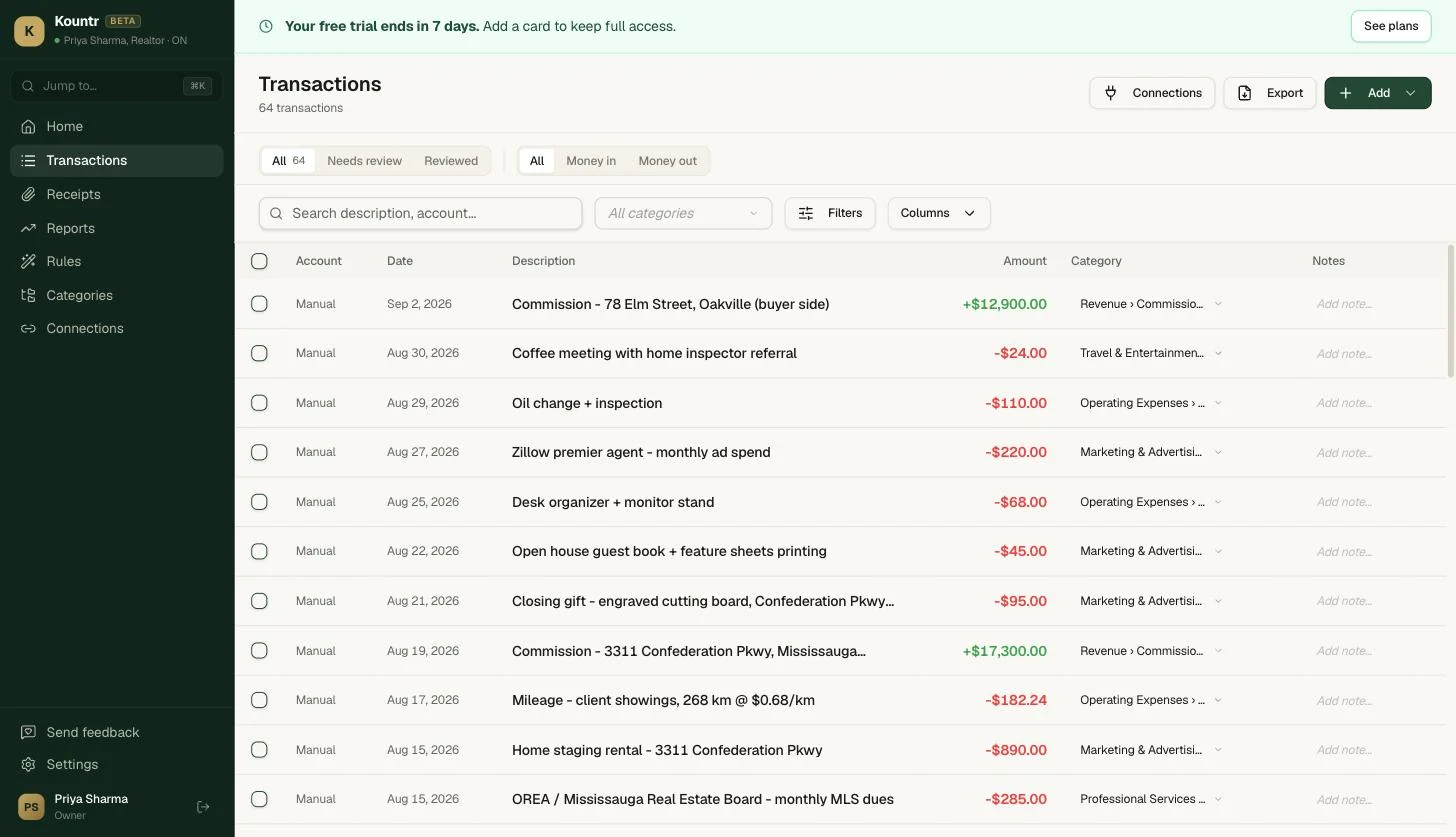
If you want a tool built specifically for Canadian freelancers that auto-categorizes transactions from your bank feed, captures HST amounts from receipts via OCR, and exports CRA-ready reports when filing time arrives, Kountr's bookkeeping software for Canadian freelancers is worth a look. It does not file your return or give tax advice — but it means your T2125 line items are already organized before you sit down with your accountant.
The best time to start tracking correctly was January 1. The second best time is today.
Quick answers
What form do freelancers use to claim business expenses with the CRA?+
Form T2125 — Statement of Business or Professional Activities. You file it as part of your personal T1 tax return. It captures gross business revenue, all deductible expenses, and calculates net business income. Net income is what flows to your T1 and gets taxed at your marginal rate. You can find the form and the accompanying T4002 guide at canada.ca.
Can I deduct home office expenses if I rent and work from a dedicated room?+
Yes. If your home is your principal place of business, you can deduct the business-use portion of rent, heat, electricity, internet, home insurance, and maintenance. Calculate your percentage using the area method (your office sq ft ÷ total home sq ft). The deduction cannot exceed your net business income for the year — any excess carries forward to next year.
What is the CRA rule on meals and entertainment as a freelancer?+
You can deduct 50% of the cost of a meal or entertainment expense that has a genuine business purpose — a client meeting, a working lunch to discuss a project, a meeting with a collaborator. Solo meals while working do not qualify. The 50% limit applies to the full cost including taxes and tip. Keep the receipt and note the business purpose and attendees.
Do I need a separate business bank account as a sole proprietor?+
The CRA does not require it legally, but mixing personal and business funds creates documentation problems that make T2125 harder to complete accurately and are a common source of errors. A dedicated business account (and ideally a dedicated business credit card) means every transaction is self-evidently business-related, which simplifies both bookkeeping and any future CRA review.
Can I go back and claim deductions I missed in a previous year?+
Yes. File an adjustment request through the CRA's My Account portal, or by mailing Form T1-ADJ. The CRA generally accepts adjustments for up to 10 years after the original assessment. There is no penalty for correcting a return in your favour. Note that any adjustment increasing taxes owed in a prior year would attract interest.